

Jagadish Chandra Bose was one of the greatest scientists India has ever produced and a true pioneer of modern science. He was not only a brilliant physicist but also a revolutionary biologist and visionary researcher whose work was far ahead of his time. His groundbreaking discoveries in wireless communication, electromagnetic waves, and plant physiology laid the foundation for several technologies that shape our world today. Even after more than a century, his scientific contributions continue to influence researchers across the globe.
Here, we will explore the biography of Jagadish Chandra Bose, along with his major inventions, research work, discoveries, and contributions to science, to understand why he is widely regarded as one of the fathers of modern Indian science and a global scientific icon.
Who Was Jagadish Chandra Bose?
He was a renowned Indian scientist, physicist, biologist, and inventor whose ideas transformed the understanding of both physical and biological sciences. He was born on November 30, 1858, in Mymensingh (now part of Bangladesh). From an early age, Bose showed a deep curiosity about nature and science, which later shaped his groundbreaking research.
He introduced the revolutionary idea that both living and non-living matter respond to external stimuli, challenging the traditional boundaries between physics and biology. This concept was considered highly innovative and controversial during his time.
Bose was also among the earliest scientists to conduct experimental research on radio waves and wireless communication, long before many Western researchers gained recognition in the field. His work laid the scientific foundation for modern wireless technology and established him as a pioneer in global science.
Jagadish Chandra Bose Biography
Jagadish Chandra ji completed his early education in India and later traveled to England to pursue higher studies. He studied at the University of Cambridge and the University of London, where he built a strong foundation in physics, natural sciences, and experimental research. His time in England exposed him to advanced scientific thinking, which played a crucial role in shaping his future discoveries.
After returning to India, Bose joined Presidency College in Calcutta as a professor of physics. There, he began conducting pioneering experiments in electromagnetic radiation, wireless communication, and the response of plants to external stimuli. Even with limited equipment and financial resources, Bose designed and built his own scientific instruments and carried out research that matched the highest international standards. His dedication and creativity helped place Indian science on the global map.’

Jagadish Chandra Bose Invention and Research
One of Jagadish Chandra Bose’s greatest scientific achievements was his pioneering work in wireless communication. He successfully demonstrated that radio waves could transmit signals over long distances without the use of wires, a discovery that became the foundation of modern wireless technology. His experiments with microwaves and radio frequencies were among the earliest and most advanced of his time, placing him ahead of many Western scientists.
In addition to his work in physics, Bose also invented several innovative scientific instruments to study the electrical responses of plants and metals. One of his most famous inventions, the Crescograph, could magnify the tiny movements and growth of plants by thousands of times. Through this device, Bose proved that plants are not lifeless but respond to stimuli just like living beings, revolutionizing the field of plant science and biology.
Wireless Communication
Long before radio technology became widely known, He was already conducting groundbreaking experiments with electromagnetic waves. He demonstrated that radio waves could travel through space and transmit signals without the need for wires, laying the foundation for modern wireless communication.
Using specially designed equipment, Bose successfully proved that electromagnetic radiation could be used for wireless signaling, a discovery that later led to the development of radio, television, mobile phones, and Wi-Fi. Although some Western scientists later received greater recognition for radio transmission, Bose’s experiments were among the earliest and most scientifically advanced demonstrations of wireless technology in the world.
Also Read:
Who is Manjul Bhargava: Life, Education, Career, Achievements & Contributions in Mathematics
C.R. Rao Biography: Discover his legacy, awards, and mathematical accomplishments
Harish Chandra Biography: The Indian Mathematician Who Inspired the World
Who was Bhaskara I? His Life, Works, Contributions to Mathematics and Astronomy
Bose’s Research on Living and Non-Living Matter
One of Jagadish Chandra Bose’s most revolutionary ideas was that both living and non-living matter respond to external stimuli. At a time when this idea was considered highly unconventional, Bose scientifically proved that metals, just like living tissues, show measurable reactions to physical forces.
Through his experiments on the interaction between magnetic fields and electrical charges, Bose discovered that metals respond to stress, heat, and electromagnetic stimulation in patterns remarkably similar to biological cells. He further studied the effects of varying magnetic fields on different materials and demonstrated that physical and biological systems follow the same fundamental laws of response.
This groundbreaking work helped bridge the gap between physics and biology, opening a new scientific field now known as biophysics. Bose’s research changed the way scientists understand life and matter, proving that the boundaries between the living and the non-living are far more connected than previously believed.
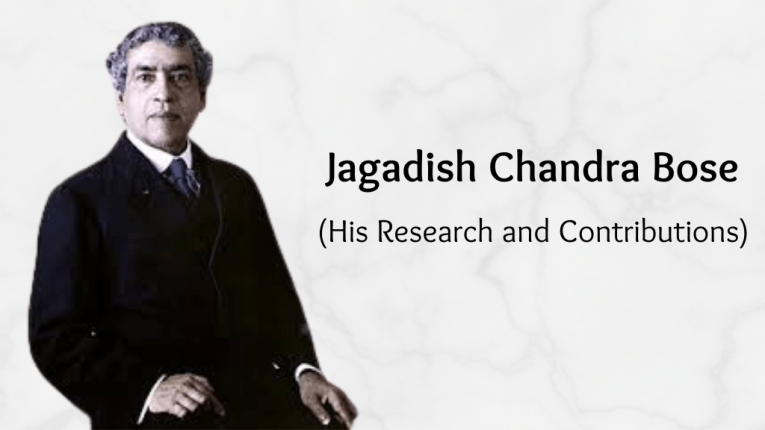
Jagadish Chandra Bose Research and Contributions
Bose was a pioneering scientist whose work spanned multiple branches of science, making him one of the most versatile researchers in history.
- Physics – Bose carried out groundbreaking experiments on electromagnetic waves, radio signals, and microwaves, laying the foundation for modern wireless communication and radar technology.
- Botany – He scientifically demonstrated that plants respond to stimuli such as touch, heat, light, and injury, proving that plants have a form of sensitivity and life.
- Biophysics – By measuring electrical signals in both plants and animals, Bose revealed deep similarities between biological and physical systems, helping establish biophysics as a new scientific discipline.
Through his interdisciplinary research, Bose successfully connected physics, biology, and electronics, changing how scientists understand life and technology. His work not only advanced science but also inspired future generations of researchers across the world.
Contribution to Modern Science
Bose transformed the scientific understanding of both communication technology and living organisms. His visionary research laid the groundwork for several modern fields, including:
- Wireless technology and radio communication
- Signal transmission through electromagnetic waves
- Plant neurobiology and plant sensitivity
- Bioelectronics and biophysics
What made Bose truly exceptional was not just his discoveries, but his values. He firmly believed that science should serve humanity, not personal profit. That is why he refused to patent most of his inventions, allowing the global scientific community to freely build upon his work for the benefit of mankind.
His legacy continues to shape modern science, technology, and our understanding of life itself.
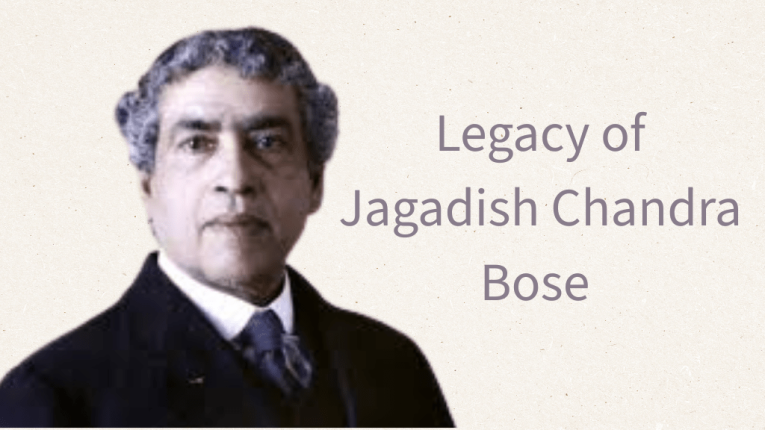
Legacy of Jagadish Chandra Bose
Jagadish Chandra Bose left behind a timeless legacy that continues to inspire generations of scientists. He founded the Bose Institute, one of India’s most prestigious research centers, which remains a hub for cutting-edge scientific study and innovation even today.
His lifelong commitment to knowledge, experimentation, and education made him a true architect of modern Indian science. He is not only advanced scientific discovery but also created an environment where young researchers could explore, innovate, and contribute to the world. His vision ensured that India would have a strong foundation in scientific research for the future.
Conclusion
Who was Jagadish Chandra Bose? He was not just a scientist, but a true visionary who bridged the gap between physics and biology, and connected technology with nature. His pioneering discoveries in wireless communication, electromagnetic waves, and plant physiology transformed the way the world understands both science and life itself.
He is proved that innovation does not depend on wealth or resources, but on curiosity, dedication, and courage. Even today, his life and work continue to inspire scientists, researchers, and students across the globe. He will always be remembered as a symbol of scientific brilliance and human progress.