
Introduction
Reasoning is one of the most important and scoring sections in competitive exams like SSC, Railway, Banking, RPF, UPSC, Police, and other government job exams. This section checks a student’s logical thinking, problem-solving skills, speed, and accuracy. Many students consider reasoning easy, but without proper practice and smart strategies, they often lose marks and waste valuable exam time.
The best part about reasoning is that it can become one of the highest-scoring subjects with regular practice and the right shortcut tricks. Unlike subjects that require a lot of memorization, reasoning mainly depends on understanding patterns, logic, and smart solving techniques.
In modern competitive exams, speed and accuracy play a very important role in achieving good scores. This is why reasoning shortcut tricks are highly beneficial for students. These smart techniques help candidates solve questions faster, avoid mistakes, manage time better, and boost confidence during the exam.
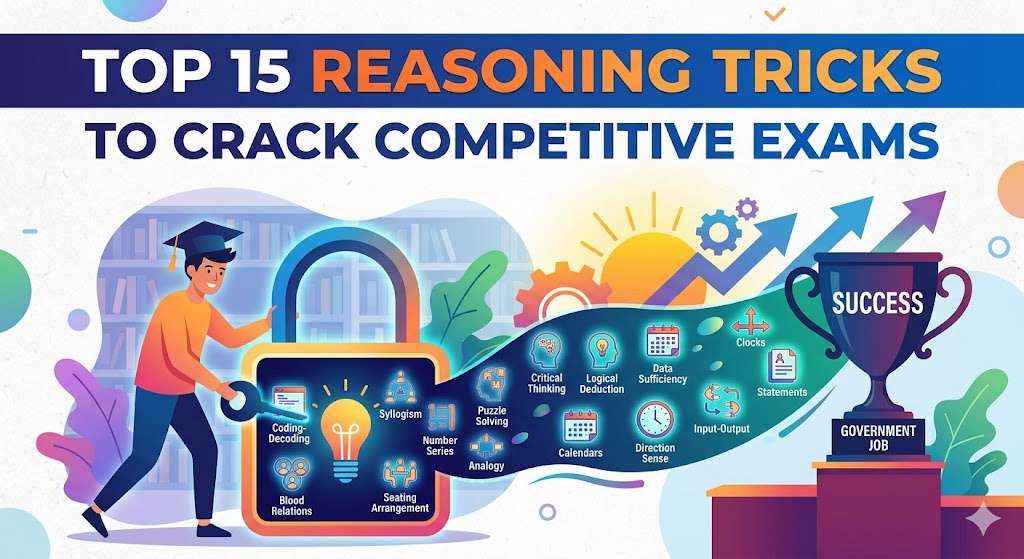
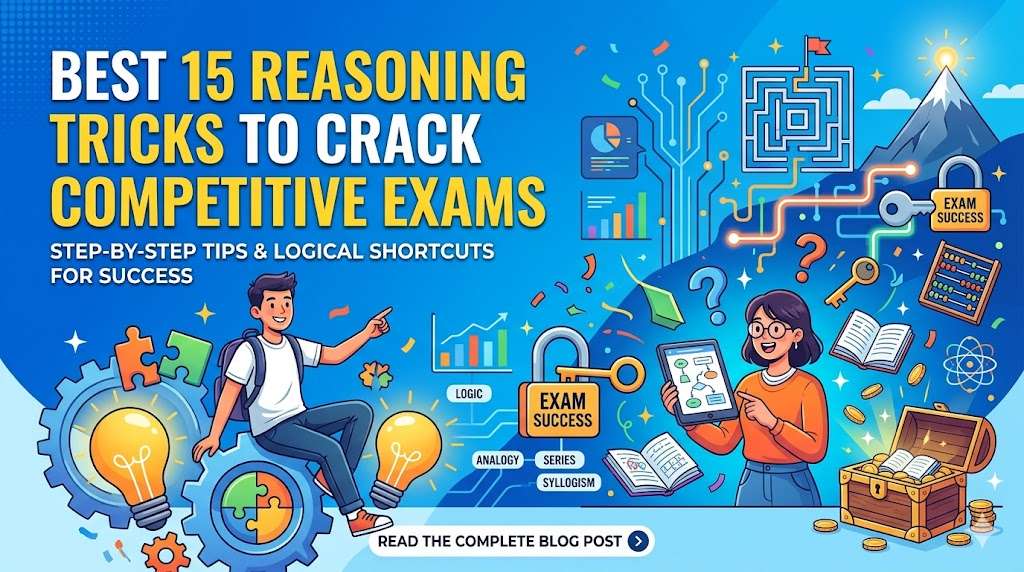
In this blog, we will discuss the Top 15 Reasoning Tricks for Competitive Exams that can help students prepare smarter, solve questions faster, and score better in exams.
Top 15 Reasoning Tricks for Competitive Exams
1. Understand the Question Carefully
Before solving any reasoning question, it is very important to understand the question properly. Many students make mistakes because they start solving too quickly without reading the question carefully.
Always take a few seconds to understand what the question is asking and what information is given.
Important Tips:
- Read the question carefully
- Read it again if needed
- Identify important keywords
- Understand all conditions clearly
- Avoid making assumptions
When you clearly understand the question, you can avoid silly mistakes, improve accuracy, and solve problems more confidently.
2. Practice Number Series Patterns
Number series questions are very common in competitive exams and can be solved quickly with regular practice. These questions usually follow a specific pattern, so students should learn to identify common number series tricks and methods.
Common Number Series Patterns:
- Addition and subtraction
- Multiplication and division
- Square and cube numbers
- Prime numbers
- Alternate number patterns
Example:
2, 4, 8, 16, 32, ?
Here, each number is multiplied by 2.
Answer: 64
The more you practice number series questions, the faster you will recognize patterns and solve questions accurately during exams.
3. Learn Coding-Decoding Shortcuts
Coding-decoding questions are commonly asked in competitive exams to test a student’s logical thinking and understanding skills. Most of these questions are based on simple alphabet patterns and letter arrangements.
Students can solve coding-decoding questions faster by learning a few basic shortcut tricks.
Important Tricks:
- Memorize alphabet positions
- Practice opposite letters
- Understand letter shifting methods
- Learn word and number coding patterns
Example:
A = 1, B = 2, C = 3
If:
CAT = C + A + T
= 3 + 1 + 20
= 24
These simple coding-decoding tricks help students improve speed, accuracy, and confidence during exams.
4. Use the Elimination Method
In many reasoning questions, solving the entire problem is not always necessary. Sometimes, you can find the correct answer faster by eliminating the wrong options first. This technique is called the elimination method and it helps save valuable exam time.
Benefits of the Elimination Method:
- Saves time
- Improves solving speed
- Reduces confusion
- Increases accuracy
This trick is especially useful in:
- Blood relation questions
- Direction sense questions
- Puzzle-based questions
- Analogy questions
By removing incorrect options step by step, students can reach the correct answer more quickly and confidently.
5. Improve Blood Relation Concepts
Blood relation questions can become much easier if students use simple symbols and family tree diagrams while solving them. These questions mainly test your understanding of family relationships and logical thinking.
Using shortcut symbols helps reduce confusion and saves time during exams.
Common Shortcut Symbols:
Male = +
Female = –
Father = ↑
Child = ↓
Creating small family tree diagrams makes it easier to understand relationships clearly and solve questions faster and more accurately.
6. Master Direction Sense Questions
Direction sense questions can be confusing if you try to solve them only in your mind. The best way to solve these questions is by drawing simple direction diagrams. This helps you understand movements and turns more clearly.
Important Direction Tips:
- Always consider North in the upward direction
- Pay close attention to left and right turns
- Track every movement step by step
- Draw rough diagrams while solving
Making a simple sketch or diagram helps reduce confusion, improves accuracy, and allows you to solve direction sense questions much faster during exams.
7. Memorize Alphabet Positions
Many reasoning questions are based on alphabet numbering, so memorizing alphabet positions can help students solve questions much faster during competitive exams.
Important Alphabet Positions:
A = 1
B = 2
C = 3
…
Z = 26
Students who remember these positions can quickly solve:
- Coding-decoding questions
- Alphabet series questions
- Ranking and ordering questions
- Word formation questions
Learning alphabet positions improves speed, accuracy, and overall performance in the reasoning section.
Also read this:
Top 50+ General Knowledge Questions for Competitive Exams | Important GK Questions
Most Important Lucent GK Topics for Competitive Exams
8. Solve Seating Arrangement Questions Systematically
Seating arrangement questions are common in competitive exams and usually require patience, focus, and a step-by-step approach. These questions become much easier when solved in an organized way.
Important Tips:
- Start with fixed positions first
- Use diagrams or tables for better understanding
- Mark positive and negative clues carefully
- Solve simple clues before difficult ones
- Avoid making unnecessary assumptions
Practicing seating arrangement questions regularly helps improve logical thinking, speed, and accuracy during exams.
9. Focus on Puzzle Solving Techniques
Puzzle questions are considered highly scoring in competitive exams, but they can also be time-consuming if not solved properly. The best way to solve puzzles is by following a step-by-step approach instead of solving them randomly.
Puzzle Solving Tips:
- Read all the statements carefully
- Create tables, charts, or diagrams
- Identify direct and easy clues first
- Eliminate impossible conditions
- Solve the puzzle in an organized way
Regular puzzle practice improves logical thinking, concentration, problem-solving ability, and overall reasoning speed.
10. Learn Venn Diagram Tricks
Venn diagram questions are commonly asked in SSC, Banking, Railway, and other competitive exams. These questions help test a student’s understanding of categories, groups, and relationships between different items.
Using simple Venn diagram tricks can make these questions much easier and faster to solve.
Important Tips:
- Understand overlapping areas carefully
- Use diagrams properly while solving
- Focus on common and uncommon regions
- Read the question and statements clearly
With regular practice, students can solve Venn diagram questions quickly and improve their reasoning accuracy in exams.
11. Practice Syllogism Shortcut Methods
Syllogism questions are an important part of the reasoning section in many competitive exams. These questions are based on logical statements and conclusions. Students can solve them quickly by learning simple shortcut methods and regular practice.
Easy Syllogism Tricks:
- Understand the meaning of All, Some, and No statements carefully
- Focus on logical relationships between statements
- Avoid assumptions outside the given information
Useful Methods:
- Venn Diagram Method
- Possibility-Based Approach
- Reverse Checking Technique
These shortcut techniques help students solve syllogism questions faster, improve accuracy, and save valuable exam time.
12. Improve Observation Skills
Reasoning questions require strong observation skills and careful attention to detail. Students who observe patterns and information quickly can solve reasoning questions faster and more accurately.
How to Improve Observation Skills:
- Solve puzzles regularly
- Practice finding differences and patterns
- Focus on small details carefully
- Analyze questions step by step
- Improve concentration while solving problems
Good observation skills help students increase problem-solving speed, reduce mistakes, and perform better in competitive exams.
13. Manage Time Properly
Time management is one of the most important factors for success in competitive exams. Even if students know the answers, poor time management can reduce their overall score.
Learning how to manage time wisely helps students solve more questions accurately within the given exam time.
Important Time Management Tips:
- Solve easy questions first
- Do not spend too much time on one question
- Skip confusing questions and return to them later
- Practice mock tests regularly
- Divide time properly for each section
Smart time management improves speed, reduces exam pressure, and helps students achieve better scores in competitive exams.
14. Practice Mock Tests Daily
Mock tests are one of the best ways to prepare for competitive exams. They help students understand the real exam pattern, improve solving speed, and build confidence.
Regular mock test practice also helps students manage time better during exams.
Benefits of Mock Tests:
- Boosts confidence
- Identifies weak areas
- Improves speed and accuracy
- Reduces exam fear and stress
- Enhances problem-solving skills
After every mock test, students should carefully analyze their mistakes and work on improving weak topics. Regular practice and proper analysis can greatly improve overall exam performance.
15. Strengthen Analytical Thinking
Reasoning is not only about learning shortcut tricks. Strong analytical thinking is also very important for solving complex and tricky questions in competitive exams. Students who develop good analytical skills can understand problems faster and find accurate solutions more easily.
Ways to Improve Analytical Thinking:
- Solve logical puzzles regularly
- Play brain games and mind exercises
- Practice previous year question papers
- Analyze difficult and complex questions carefully
- Focus on understanding patterns and logic
Strong analytical thinking improves problem-solving ability, increases accuracy, and helps students solve challenging reasoning questions with confidence.
Common Mistakes Students Should Avoid
Many students make common mistakes during reasoning preparation that affect their speed, accuracy, and overall exam performance. Avoiding these mistakes can help students score better in competitive exams.
Common Mistakes:
- Ignoring basic concepts
- Practicing questions without proper understanding
- Skipping mock tests and practice sessions
- Not analyzing mistakes after solving questions
- Poor time management during preparation
- Becoming overconfident
- Lack of regular revision
Students should focus on understanding concepts, practicing consistently, and learning from their mistakes. By staying away from these common mistakes, students can improve their confidence, increase accuracy, and achieve better results in competitive exams.
Best Topics to Focus on in Reasoning
Students preparing for competitive exams should focus more on high-scoring and frequently asked reasoning topics. Strong preparation in these areas can help improve speed, accuracy, and overall exam performance.
Important Reasoning Topics:
- Number Series
- Coding-Decoding
- Blood Relation
- Direction Sense
- Seating Arrangement
- Puzzle Questions
- Syllogism
- Analogy
- Classification
- Alphabet Series
- Ranking and Order
- Statement and Conclusion
These topics are commonly asked in exams like SSC, Railway, Banking, RPF, Police, and other government job exams. Regular practice of these topics can help students score better in the reasoning section.
Benefits of Learning Reasoning Tricks
Learning reasoning tricks offers many advantages:
1. Faster Problem Solving
Shortcut methods reduce solving time.
2. Better Accuracy
Logical techniques minimize mistakes.
3. Higher Scores
Students can attempt more questions correctly.
4. Improved Confidence
Practice and tricks reduce exam fear.
5. Better Time Management
Students can save time for difficult sections.
Reasoning tricks are extremely useful for competitive exam success.
Conclusion
Reasoning is one of the easiest and most scoring sections in competitive exams when prepared with the right strategy and regular practice. Students who learn smart reasoning tricks and practice consistently can solve questions faster, improve accuracy, and save valuable exam time.
The Top 15 Reasoning Tricks discussed in this blog can help aspirants boost their speed, confidence, logical thinking, and overall exam performance in SSC, Railway, Banking, RPF, Police, and other government job exams.
Doing well in reasoning is not just about learning shortcut tricks. Regular practice, logical thinking, patience, and good time management are equally important for achieving success in competitive exams.
If you want to crack competitive exams successfully, start practicing reasoning questions daily and apply these shortcut techniques regularly. With dedication, smart preparation, and consistent effort, you can score excellent marks in the reasoning section and move closer to achieving your dream government job.